
There is a hidden epidemic in the communities that resist help.
Corrections officers, law enforcement, wildland and structure fire crews, service members, veterans, healthcare workers — surrounded by colleagues, yet profoundly alone. Ubeus is a deployed, in-production platform that takes 60 seconds a day, carries no clinical label, and puts support in the hands of the crew they already trust.
Billions go to programs they won’t use.
The people who run toward what everyone else runs from believe they can’t show weakness or ask for help. So they suffer alone, and it surfaces as substance abuse, broken relationships, burnout, attrition, and at the extreme, suicide.
Traditional behavioral health programs ask a question that presumes damage: “What’s wrong with you?” For a workforce whose identity is built on being the one who copes, answering that question feels like ending a career. Utilization stays in the single digits while the need keeps climbing.
Ubeus was built around the opposite premise. It is a build model, not a repair model — and that reframe is why high performers who avoid clinical programs to protect their careers will actually use it.
Ubeus asks a question that presumes agency: “How do you want your life to be right now?” Living Ideation · Steven Nicholas, Ed.D., LMFT
Source: U.S. Surgeon General’s Advisory, Our Epidemic of Loneliness and Isolation (2023). See the full evidence base →
Sixty seconds a day, and the crew sees what matters.
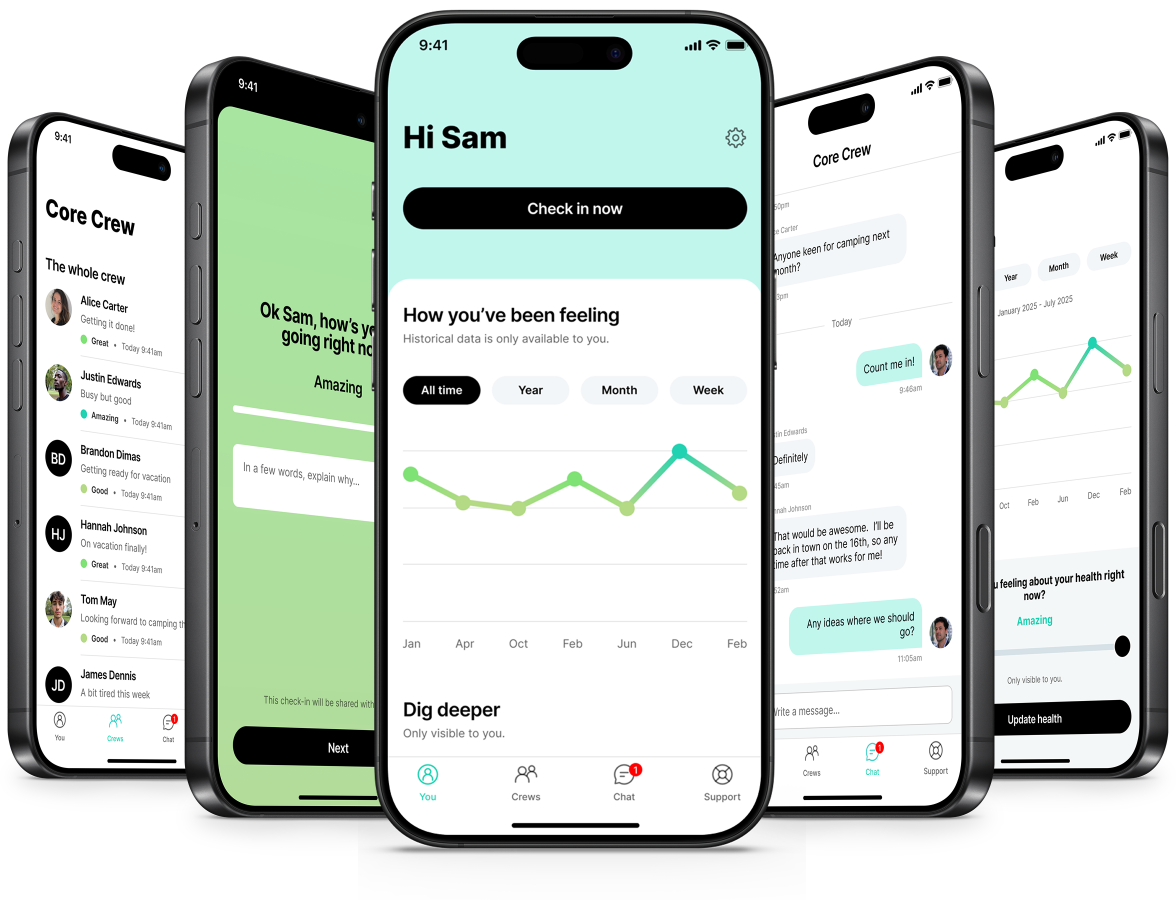
Four moving parts. No intake queue, no diagnosis, no clinical vocabulary anywhere in the experience.
Check in
Two questions a day: how you feel right now, and how you want your life to be. A slider, not a symptom inventory. Private notes optional.
Crews
Private, invitation-only groups by shift, unit, station, or cohort. No public feed, no algorithm, no strangers.
Rally Around
Anyone reporting distress — or gone silent for seven days — rises to the top of every crewmate’s screen. A quiet signal to reach out, not an alarm.
Support
One tap to 988, 911, and crisis text lines — alongside the department’s own EAP, chaplains, peer team, and union resources.
Why it reaches the people other programs miss.
Built for the workforce that resists help
A build model, not a repair model. Nothing in the app asks a member to identify as damaged, so using it costs them nothing professionally.
Peer-visible early warning
Crewmates see distress and silence in real time, so intervention comes from trusted colleagues in hours — not from a clinical intake queue in weeks.
Clinically founded, not clinically packaged
Created by a licensed marriage and family therapist and ICISF national instructor with 20+ years embedded with military, wildland fire, structure fire, and law enforcement.
Private by architecture
Journal entries never leave the device unless shared. Sharing is crew-only. Crewmates see today’s status, never the history behind it.
Proven at agency scale
A paying state-government deployment covering roughly 3,000 employees, plus active fire cohorts. In production, not concept stage.
Low-lift acquisition and sustainment
Per-seat subscription, no capital outlay, no agency servers, and nothing stranded when grant funding ends — the continuation plan reviewers require.
One platform, configured per agency.
Resource libraries, crew structures, and onboarding are tailored to the mission and duty cycle of each workforce — without a separate build or a new app release.
Already carrying real caseloads.
Nevada Department of Corrections
Agency-wide deployment to approximately 3,000 employees with a department-tailored resource library covering EAP, chaplaincy, peer support, and union resources. Ubeus is the paid, in-production wellness platform for the department’s workforce.
Truckee Meadows Fire & Rescue
Structure fire crews, run through the department’s peer support team with a station- and shift-aligned crew structure and a district-specific resource library.
Prior federal delivery
Resilience and critical-incident work delivered by Dr. Nicholas with the Nevada Air National Guard, U.S. Wildland Fire Service and U.S. Forest Service wildland fire crews, and municipal fire and law enforcement agencies.
University of Nevada, Reno
Pilot cohorts with student athletes and medical students — two populations with the same reluctance to seek help and the same tight-knit crew structure.
Evaluating Ubeus for an agency?
Start with the capability statement — core competencies, differentiators, past performance, UEI, NAICS and PSC codes, and both principal contacts on one page.
Joining your crew?
Ubeus is free to download on iOS and Android. If your department has invited you, create an account and follow your invite link to join automatically.