
A public health crisis with a well-documented protective factor.
Ubeus is not built on a hunch about technology. It is built on what the research says actually protects people — and on twenty years of clinical practice inside the workforces that need it most.
In 2023, the U.S. Surgeon General issued an advisory about loneliness.
Not about a virus. Not about opioids. Dr. Vivek Murthy called it “our epidemic of loneliness and isolation” — a public health crisis hiding in plain sight, more prevalent than diabetes, obesity, or smoking.
The mortality comparison that reframed the field
Lacking social connection increases the risk of premature death by roughly the same margin as smoking up to 15 cigarettes a day — and by a larger margin than obesity, physical inactivity, or air pollution.
This is the finding that moved loneliness out of the category of a mood problem and into the category of a mortality risk factor. It is also why a wellness intervention that measurably increases connection is a legitimate health investment rather than a morale program.
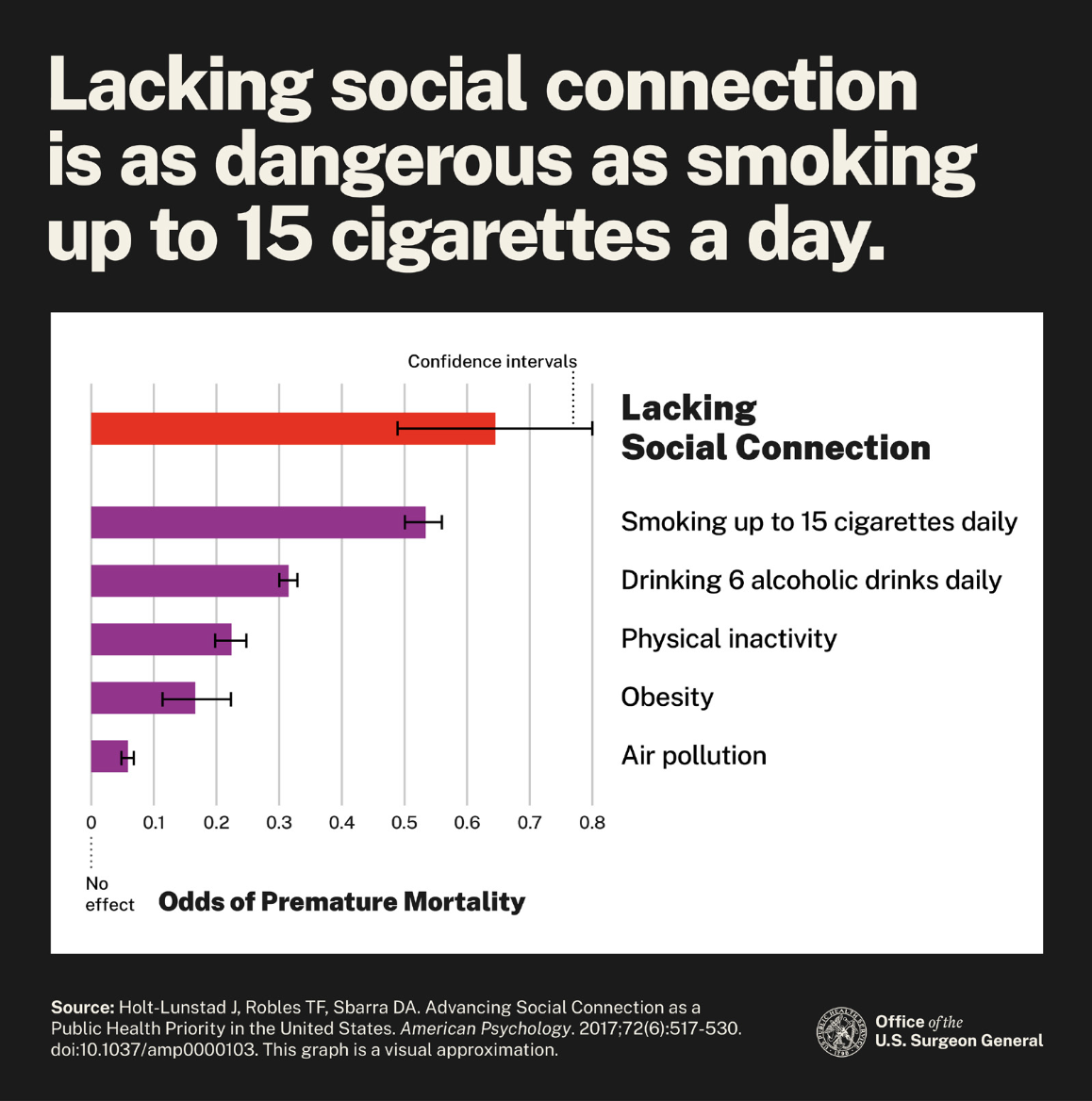
Graphic: Office of the U.S. Surgeon General. Source: Holt-Lunstad J, Robles TF, Sbarra DA. Advancing Social Connection as a Public Health Priority in the United States. American Psychologist. 2017;72(6):517–530.
We built the most connected society in history and made it lonelier.
The Surgeon General’s advisory calls this out directly: people who use social media more than two hours a day have double the odds of reporting social isolation compared to those using it less than 30 minutes.
Social networks do not deliver connection. They deliver performance. You broadcast a curated life to everyone you have ever met plus millions of strangers — and even a perfect performance can be trolled. Meanwhile the people who actually matter have no idea how you are really doing, because you cannot be vulnerable on a platform built for an audience.
We don’t need another social network. We need the opposite: a private space to be honest with the people who already matter.
That is the design brief for Ubeus. No public feed. No algorithm. No follower count. No discovery. Membership by invitation, visibility limited to the crew, history visible only to the member.
A build model, not a repair model.
Dr. Steven Nicholas spent two decades studying why traditional approaches to mental health fail in exactly the populations that need them most — and built a different starting question.
“What’s wrong with you?”
- Treats the person as broken and the goal as restoration
- Opens with symptoms, deficits, and diagnostic categories
- Participation reads as an admission of failure — and, in a public safety career, as a professional risk
- Utilization stays low precisely where risk is highest
“How do you want your life to be right now?”
- Treats the person as capable and the goal as construction
- Opens with direction, strengths, and agency
- Participation reads as ambition, not damage — nothing to disclose, nothing to defend
- Rebuilds connection inside the community that already exists
The research is consistent on the protective side of the equation: the strongest protection against loneliness and its health consequences is meaningful connection with other people. Not followers. Not likes. Relationships in which you can be honest about how you are doing.
Most people are not short of community. They have families, crews, shifts, congregations, teams. What they lack is a safe way to be vulnerable inside it. Asking for help feels awkward; admitting you are struggling feels weak. So everyone stays silent, and everyone assumes they are the only one.
Ubeus operationalizes Living Ideation into a daily habit: a question that presumes agency, answered in 60 seconds, visible to a crew that can act on it.
The populations where the gap between need and utilization is widest.
Cumulative exposure
Corrections, law enforcement, fire, EMS, dispatch, and military populations absorb repeated critical incidents as a condition of the job, across rotating shifts that never align with business-hours services.
Career-risk stigma
In these professions, seeking behavioral health support carries a perceived threat to fitness-for-duty, assignment, and advancement. That perception, not availability, is the binding constraint on utilization.
Existing crew structure
These workforces already operate in tight, trusted units. The social infrastructure Ubeus depends on is not something an agency has to create — it is already there, organized by shift and station.
Bring the evidence to your agency.
We support wellness coordinators and grant writers directly with program descriptions, deployment detail, and past-performance language.